 FEATURES

Prepared by the Waapihk Research Team. Waapihk Research summarizes the key highlights from Budget 2026 and what they mean for Indigenous governments and communities.
AT A GLANCE: Budget 2026 makes longer-term funding commitments to First Nations housing and infrastructure and renews core services. However, the budget provides few funding details beyond the fifth year; most larger funding starts only in 2027-28, and Métis, urban, and off-reserve residents appear to be underfunded.
OVERVIEW: Budget 2026, Masters of Our Destiny, was tabled on November 5, 2026. Its chapter on Reconciliation promises $26.6 billion over five years and $32 billion over 10 years with a focus on First Nations housing and infrastructure. After years of year-to-year funding, this certainty is welcome. Beneath the headline, though, the picture is mixed: much of the funding goes to renewing existing programs, and a large share is provided later.
Here are six highlights we think matter most:
- Infrastructure and Housing: ten-year certainty, with most funding provided after 2027-28.
- Education, Children, and Families: renewed, but on five- to six-year cycles.
- Health and Safety: funding renewed for another three to four years, but the need is ongoing.
- Emergency Preparedness and the North: stronger funding for response, but clear, reliable funding is needed for prevention.
- Ownership and Fiscal Powers: equity stakes and tax powers, alongside the promise of faster approvals with “one project, one decision, one year”.
- Who and What is Left Out: Métis, urban and off-reserve people, languages, and one-year funds.

1. Infrastructure and Housing
Budget 2026 commits $32 billion over 10 years to First Nations housing and infrastructure, including $18.5 billion for the First Nations On-Reserve Infrastructure Program and $11 billion for core housing. This amount is intended to maintain 119,000 housing units, build 6,900+ new homes, and renovate 10,900+ existing units. On-reserve First Nations communities will receive $1.7 billion over five years to deliver housing projects faster. Water infrastructure will receive $4.6 billion over five years, including $226.7 million for the Atlantic First Nations Water Authority.
The larger share of funding, including $18.5 billion for on-reserve infrastructure, starts only in 2027-28. Our analysis of the five-year funding table shows that only about a quarter of the $32 billion falls in that window, and the budget does not show how the rest is spent. Additionally, the Assembly of First Nations (AFN) estimates on-reserve First Nations infrastructure gaps at $376.1 billion over the next decade. The proposed funding amount therefore appears to fall well short of existing needs.

2. Education, Children, and Families
First Nations K-12 education will receive $5.8 billion over five years, with another $437.9 million for the Post-Secondary Student Support Program. Jordan’s Principle has been renewed with $6 billion in funding over six years, and an additional $575 million will be provided over five years to the Inuit Child First Initiative. Implementation of An Act respecting First Nations, Inuit and Métis children, youth and families is set to receive $806.7 million.
However, the five- to six-year funding term is far shorter than the ten-year housing commitment. Time-limited renewals may create service gaps and leave families, schools, and service providers unsure what happens when the funding ends.
3. Health and Safety
Non-Insured Health Benefits is promised $2.9 billion over three years from 2027-28. Public health will receive $290.7 million over four years, and $633.7 million will go to the First Nations and Inuit Policing Program over that timeframe, with another $250.9 million ongoing. Community-led safety will receive $140 million over four years, and the Red Dress Alert pilot will receive $3.6 million in 2027-28.
However, health and safety needs are ongoing, and shorter-term funding risks service gaps and makes it difficult to plan and retain skilled workers. First Nations Chiefs have called for reform of the health benefit program, following the death of Miranda Mamakwa, a mother of three from Fort Severn First Nation. These reforms may need to be built into future budgets as development and implementation could take longer than three years.

4. Emergency Preparedness and the North
After the 2026 wildfire season evacuated 33,750 people, including more than 8,800 from Indigenous communities, Budget 2026 promises $865.6 million in 2026-27 and $446.2 million ongoing for the Emergency Management Assistance Program. This is complemented by another $7.8 million and $7 million ongoing for wildfire and fire protection. Investment in northern and coastal regions includes $186 million over four years for the Great Bear Sea environmental and economic framework, and $610.3 million for Nutrition North.
However, the 2026-27 funding is small, and communities need proactive, clear, and reliable long-term funding for prevention and recovery. Inuit Tapiriit Kanatami has stated that Nutrition North has not improved food security.

5. Ownership and Fiscal Powers
The budget leans into Indigenous equity. A $10 billion Indigenous Loan Guarantee Program is underway, with a $715 million loan guarantee for seven Williams Treaties First Nations as part of the Darling nuclear project. Additionally, 128 groups have been offered a 15% stake in the Trans Mountain Corporation (fossil fuel pipeline). The personal income tax revenue-sharing rate for First Nations is also set to rise from 95% to 99%, and $78.5 million over four years will support the First Nations Fiscal Management Board, Tax Commission, and Infrastructure Institute.
The “one project, one decision, one year” approach and a new Crown Consultation Hub could accelerate approval of new projects. Budget 2026 claims that Section 35 rights and the duty to consult are unchanged, and $119 million is provided for modern treaty negotiation until 2029-30. Still, shorter approval timelines could put pressure on consultation in practice. Respecting Nations’ agency remains important, as Nations may not wish to participate in co-ownership of energy projects, and some may never have the opportunity.

6. Who and What is Left Out
“Métis” appears only in the title of the Child and Family Services Act and the Métis National Council, which the Manitoba Métis Federation has recently criticized for a lack of inclusion. Additionally, urban and off-reserve needs must be addressed using at least 10% of the Indigenous share of Build Canada Homes funds with a dedicated dollar amount. Our analysis also found no stated funding for Indigenous languages and no mention of the United Nations Declaration on the Rights of Indigenous Peoples (UNDRIP).
Some programs also operate on one-year funding, all in 2027-28: the National Centre for Truth and Reconciliation ($5 million), the Indigenous Justice Strategy ($10 million) and the Royal Canadian Mounted Police (RCMP) Legacy Residential School funding ($1 million). A one-year funding cycle makes it hard to plan, hire, retain, and maintain trust with the people these programs serve.

What Needs to Change:
To improve Budget 2026 and advance Reconciliation, Canada must:
- Show clear breakdowns of ten-year spending. Clarify how much of the promised funding is spent after year five and publish yearly progress against the gap.
- Leave no one behind. Add distinction-based funding lines for Métis, and fund urban and off-reserve needs and Indigenous languages with named amounts.
- Move beyond one-time and short-term funding. Make justice, Truth and Reconciliation, and Red Dress Alert funding multi-year, while extending health funding commitments to ten years.
- Co-develop reform and renew early. Reform health benefits, develop consultation changes with Nations, and renew programs before they expire.
In Summary:
Budget 2026 offers long-term funding for housing and infrastructure, stronger core services, and new opportunities for ownership, yet it shows few details on spending beyond five years, creating uncertainty. There are trade-offs: federal fiscal limitations are real, and fixed ten-year plans give communities predictability that annual funding does not. Stable, predictable, long-term funding will turn these commitments into progress, and strong Nations, led by their own people, have shown they can do the rest.
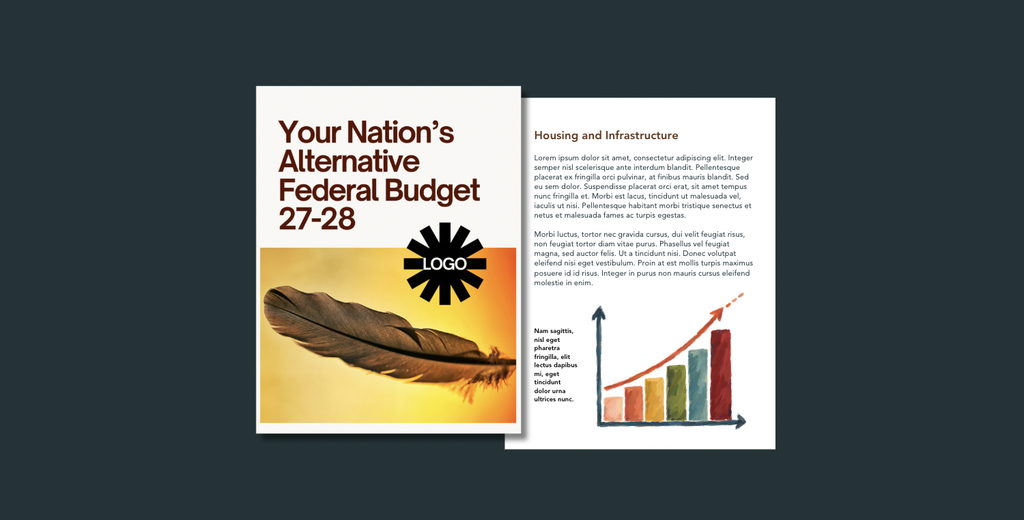
Build Your Nation’s Alternative Federal Budget:
What would it take to close the gaps and meet your community’s needs?
Your Nation’s priorities deserve to be reflected in the decisions that shape its future.










Share the article